Play Garageband Ipad Files
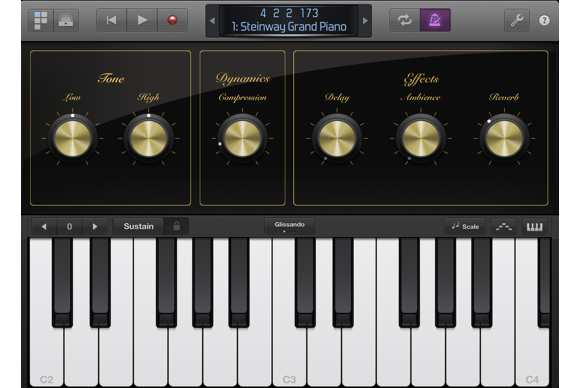
Oct 09, 2019 1) On the main GarageBand screen (Your Songs) tap and hold the song you want and select Share. 2) Choose Song. 3) Select the audio quality, adjust details if necessary, for artist, composer, and album. 4) Pick from your sharing options like Messages, AirDrop, Mail, SoundCloud,. Windows based program to edit garageband files? If you're new to the TechRepublic Forums, please read our TechRepublic Forums FAQ. All submitted content is subject to our Terms Of Use. Jun 17, 2016 In its current state, your tune can only be played within GarageBand, so you need to export it — or “bounce it down” — to a single audio file that can be played in common audio applications. Here’s how to share GarageBand files with someone on your holiday list. But before we wrap up this extensive iPad GarageBand Tutorial there are a final few instructions that will help you to get your created music off of iPad, into your Personal devices and maybe even to millions out there via iTunes. SHARING CREATED FILES FROM GARAGEBAND. Return to the Main Menu by tapping on the My Songs Button. Key Features of GarageBand. Before learning how to download GarageBand for Windows PC, let us look at its features to understand if this is the right tool to help your musical aspirations. Let’s start by noting that GarageBand is easy to use and very fun to explore, given that it has a whole bunch of features to use. Play the Keyboard in GarageBand for iPad. Using the Keyboard Touch Instrument, you can play different keyboards, including grand piano, electric piano, organ, clavinet, and synthesizer, by tapping the keys. You can choose a keyboard sound, move higher or lower on the keyboard, hold notes, and change the keyboard layout and size.
- Ipad Garageband Guitar
- Play Garageband Ipad Files For Pc
- Play Garageband Ipad Files For Mac
- Play Garageband Ipad Files Software
- Play Garageband Ipad Files For Windows 10
- Garageband For Ipad App
GarageBand exports exactly one file format — the Audio Interchange File Format (with extensions of aif, aiff, AIF, or AIFF). Fortunately, AIF files are the gold standard of audio files, the highest-of-high-quality uncompressed audio that you can save on a disc. AIF files sound great, but a cost is incurred: The files are huge — too big to send via e-mail or download or to stream from the Internet.
AIF files are, by definition, uncompressed. They’re usually five to ten times the size of a song in its compressed form (that is, encoded or ripped). Other audio file formats, such as MP3 and AAC, are compressed and are much smaller, by 50 to 95 percent, than the same song uncompressed.
Sound quality
Compression, by its nature, takes away part of the sound. In theory, it’s the part that people can’t hear, but some people do notice a big difference between uncompressed audio and compressed audio, even on cheap stereo systems. Others can’t tell any difference.
Some people can hear the difference between compressed audio files that are encoded (ripped) at bit rates of 160 and 192 Kbps. Others hear no difference.
The smaller, compressed audio files sound good enough to most people most of the time and have become a de facto standard for consumer audio.
iPods (and most other personal music players) and iTunes (and most other personal music-playing software not made by Microsoft) can play both uncompressed and compressed files. But most people store most of their music as compressed audio files, allowing five, eight, or even ten times as many songs to be stored in the same amount of hard drive space.
The compressed file formats can encode your song at different bit rates. The higher the bit rate, the better the song will sound. Alas, the higher the bit rate is, the bigger the file will be.
Choosing a compression type
The quality of an AIF file is top-of-the-heap because it, by definition, contains 100 percent uncompressed audio. Nothing has been added or removed; every note, breath, harmonic, overtone, string noise, buzz, hiss, and other sound in the master recording is in an AIF file.
Technically, the files on an audio CD are “Red Book Audio” files, which are slightly different from AIF files. The technical aspects aren’t important; the important part is that when you shove an audio CD into your Mac, it sees Red Book Audio files and automatically thinks of them as AIF files. No conversion or translation is needed — to your Mac, Red Book Audio files are AIF files, and vice versa, even if the rest of the world says that Red Book and AIF are different.
The problem is, while uncompressed audio may be the right format for shiny silver discs, it’s not the right format for e-mail or the Web, because AIF files are gargantuan.
Fortunately, if you have GarageBand, you also have the right tool for compressing AIF files, and in fact, that tool is already open and ready to rip. That tool is GarageBand’s iLife sibling, iTunes. With iTunes, it’s child’s play to compress (rip or encode) AIF files into MP3, AAC, or even Apple’s new high-quality lossless encoder, and it’s all done behind the scenes using iTunes built-in (and very high-quality) encoders.
MP3 and AAC are the two most common compressed audio file formats on the Mac. MP3 came first and has essentially been the compressed audio standard for many years. Then, a couple of years ago, when Apple introduced the iTunes Music Store, it also introduced the AAC file format, which it uses for the store’s rights-protected songs.
Figure 1 is worth a couple of thousand words — it shows the same song saved in all four formats and the size of each file.

Table 1 is a handy reference to the different file types and the common ways in which each type is used.
Figure 1: Compare the file size of the same song saved in four different file formats.
Table 1: File Types Large and Small
File Type | Compressed? | What’s It Good For? |
AIF | No | Audio CDs, iTunes, and archiving music in the file format that retains the most audio information. Can be used with iPod, but files are 5–10 times the size of compressed formats. |
WAV | No | The equivalent of an uncompressed AIF file on a Mac, this format is used for sharing files with Windows users. File sizes are 5–10 times the size of MP3 files, which is the compressed file format of choice among Windows users. |
Apple lossless | No | iTunes and archiving music in the file format that retains the most audio information. Can be used with iPod but files are 3–7 times the size of compressed formats. |
MP3 | Yes | iTunes, e-mail, the Web, and sharing with Windows users. Files are much smaller than either uncompressed format, making MP3s ideal for iPods. |
AAC | Yes | Same as MP3 but is Mac-only. Slightly smaller files than MP3 and slightly better sound quality in those slightly smaller files. Most Windows users can’t use AAC files. |
Ipad Garageband Guitar
In iOS 11, the My Songs browser in GarageBand works together with the Files app to keep your songs up to date across all your iOS devices. To browse your songs when you have a song open:
- On your iPhone, tap , then tap My Songs.
- On your iPad, tap My Songs.
Browse songs
To browse locations where you've stored songs, tap Browse in the My Songs browser—you might have to tap more than once. In the Browse menu, tap a location to open it in the browser. Locations can include your device and iCloud Drive.
And, not surprisingly, it was fun to tap away at the onscreen keyboard and drum set using only my thumbs. I made a complete (albeit heinous-sounding) song in a matter of minutes. Garageband for iphone 4s free download software.
You can also browse your songs by doing any of the following:
- To see songs you’ve opened recently, tap Recents.
- To look for a specific song, tap in the Search field at the top of the window, then enter all or part of the name of the song.
- To sort songs by different criteria, tap Name, Date, Size, or Tag.
- To view the documents as thumbails or a list, tap .
- To see the documents that share a tag, tap a tag in the Browse menu.
Organize your songs with folders and tags
You can keep your songs organized by creating folders and storing songs in them. To create a folder:
- Tap Browse in the My Songs browser then tap a location.
- Swipe down, then tap .
- Name the new folder, then tap Done.
- To create a new song in that folder, open the folder, then tap Create Document. GarageBand automatically saves the song in that location until you move it.
Play Garageband Ipad Files For Pc
You can also use tags to organize your songs and audio files. Tags make it easy to quickly find the song or other file you need.
Tag a song
- Tap Select, then tap the document thumbnail so a checkmark appears on it.
- Tap Share on your iPad, or tap on your iPhone, then tap .
- You can select an existing tag, or create your own. To create your own tag:
- Tap Add New Tag.
- Enter a name for the tag and select a color.
- Tap Add Tag. You can tag documents with the new tag, and the tag also appears in the Browse menu.
Manage tags
Play Garageband Ipad Files For Mac
- Tap Browse to open the Browse menu, then tap Edit.
- Tap the name of an existing tag.
- Then enter the name of your new tag.
- Tap Done.
Manage songs
You can share, move, copy, and delete songs in the My Songs browser or the Files app. Tap Select, tap the document thumbnail so a checkmark appears on it, then tap the option you want at the bottom of the screen.
- To share a song, tap Share on your iPad, or tap on your iPhone, then choose how you want to share the song.
- To copy or move the song to another folder or location, tap Move on your iPad, or tap on your iPhone, select the new location, then tap Copy or Move. If you’re copying songs between locations from iCloud Drive to your device, a copy of the song remains in the original location.
- To delete a song, tap Delete on your iPad, or on your iPhone.
Work with audio files
If you want to use audio files in GarageBand for iOS 2.3, use iTunes File Sharing on your Mac or PC to add them to your iOS device. Then, access the files from the GarageBand File Transfer folder on your iOS device.
To add audio files to your device using iTunes File Transfer:
- Open iTunes on your Mac or PC.
- Connect your iPad or iPhone to your computer using the USB cable that came with your device.
- Click your device in iTunes. Get help if you can't find it.
- In the left sidebar, click File Sharing.
- Select GarageBand, then drag files from a folder or window onto the Documents list to copy them to your device.
If you’re upgrading to GarageBand for iOS 2.3 and have existing audio files on your device, GarageBand automatically moves the files to the GarageBand File Transfer folder after upgrading.
Play Garageband Ipad Files Software
Add audio files to your song
After you've added the audio file to the GarageBand File Transfer folder, you can them add the audio file to your song.
- Open GarageBand on your iOS device, and open the song you want to add an audio file to.
- If necessary, tap to open the song in Tracks view.
- Tap to open the Loops browser. If a dialog appears asking if you want the files moved to the GarageBand File Transfer, tap Move Files.
- Tap Audio Files, then drag the file to the Tracks area in GarageBand.
Add audio files from a third-party cloud service
If you want to add audio files saved in a third-party cloud service or another location, copy them to the GarageBand File Transfer folder using the Files app.
- Open Files app, then tap Browse.
- In the Browse menu, tap the location where the file is stored, then locate the file.
- Tap Select, then tap the file so a checkmark appears on the file.
- Tap Move, tap On My [device], then tap the GarageBand folder.
- Tap the GarageBand File Transfer folder, then tap Copy. You can now add the file to your song using the Loops browser in GarageBand.
Play Garageband Ipad Files For Windows 10
Learn more
Garageband For Ipad App
- Learn more about using third-party cloud services with GarageBand for iOS.